Sunday, 14 September 2014

2015 Facelifted Peugeot 508

Background Information
4 years after Peugeot launched it's D-Segment fighter, the 508, it has been given a new lease of life with a facelift.

Peugeot had replaced the 407 and 607 with a the 508 back in 2011. It was situated to be more upmarket than the 407 and a little bit less than the 607 and in most ways it has been successful.

The French positioned the Peugeot against the likes of the Vauxhall (Opel) Insignia, Volkswagen Passat, Ford Mondeo etc.

The 508 is based on the same platform used by the Citroen C5 and C6 as they're both in the PSA Group so it makes sense to share components.

For the facelift the 508 has gained cosmetic and technology upgrades along with more efficient engines with the cleanest engine emitting just 104g/km of CO2 meaning just £20 road tax a year, good news for private buyers then.

Pricing will start at £22,054 for a 1.6 e-HDi saloon and £23,245 for the SW Estate in Active trim which comes generously equipped sat-nav, 18-inch alloys, rear parking sensors and dual-zone climate control all coming as standard.

Stepping up to mid-range Allure trim gets additional equipment such as parking sensors all-round, keyless entry and go, electric parking brake, reversing camera and a panoramic roof for the SW as standard. Prices start from £24,895 for the saloon and £26,295 for the SW equipped with the 1.6 e-HDi engine for both.

Range topping GT trim comes only with a 2.2 HDi 200 diesel and is priced from £30,645 for the saloon and £32,045 for the SW and comes equipped with (on top of Allure) a heads-up display, 19-inch alloys and nappa leather.

The RXH four-wheel drive model which has only 1 body style, the SW, costs £30,295 when equipped with the 2.0 HDi 180 diesel or the diesel-electric Hybrid4 2.0 HDi costing £34,645 with additional trim in both models consisting of half-leather trim and electrically adjustable front seats.

Sales have began in some countries in Continental Europe starting on the 10th September.


Engines
Diesel
1.6 HDi 115PS (113BHP)             single turbo 4 cylinder
2.0 HDi 140PS (138BHP)             single turbo 4 cylinder
2.0 BlueHDi 150PS (148BHP)      single turbo 4 cylinder
2.0 HDi 163PS (161BHP)             single turbo 4 cylinder
2.0 BlueHDi 180PS (178BHP)      single turbo 4 cylinder
2.2 HDi 200PS (197BHP)             single turbo 4 cylinder

Diesel-Hybrid
2.0 HDi 163PS (161BHP) linked with a 36BHP electric motor

CO2 Emission (g/km) figures have been released on some engines:
1.6 HDi 115PS (113BHP)                      104g/km
2.0 BlueHDi 150PS (148BHP)              109g/km
2.0 BlueHDi 180PS (178BHP)              119g/km
2.0 HDi 163PS (161BHP)
linked with a 36BHP electric motor      91g/km


Size
The facelifted 508 has the similar dimensions as the pre-facelifted despite the fact new front and rear bumpers are in place.

Dimensions are as follows:
Wheelbase: 2817mm
Length: 4792mm
Width: 1853mm
Height: 1456mm


Interior
The 508 prior to the facelift had an exceptional quality interior for a Peugeot and it has improved even further with more soft touch materials and higher quality materials used throughout the cabin.

All models gain a 7-inch touchscreen which can connect to Peugeot ConnectApps which displays real-time information such as nearby parking spaces available, fuel prices, the local weather and the latest traffic information.

Interior space has remained the same with good legroom for rear passenger although those above 6ft will have their heads brushing the roof of the vehicle. A third center rear passenger will be relatively happy as no transmission is present leaving room for the occupant to place their feet there.

A criticism with all Peugeot is the size of the glovebox which is rather small due to the fuse box in place as Peugeot decide not to move it to the right in right-hand drive vehicles, in fact you could probably only stick a cupcake in it and it would be full!


Exterior
The grille mirrors that of the latest Peugeot 308 and facelifted 3008 and 5008. New headlights and taillights are present on the saloon while new the rear remains unchanged in the SW.

The rear lights on the saloon are now fully LED with 36 LED's arranged in the now trademark (for Peugeot's) three claws light with all models featuring LED daytime running lights, LED indicators and LED sidelights with Allure, GT and RXH models featuring full LED headlights.

The Peugeot is one of the more stylish vehicles in it's class along with the Vauxhall (Opel) Insignia, Kia Optima and the Hyundai i40.


My Opinion
I liked the pre-facelift 508 and got a real sense of quality when I sat in one with soft touch plastics dotted around the cabin, nicely weighted buttons and a nice thick rimmed steering wheel covered in soft leather.

The only real letdowns are the tiny glovebox and the design flaw in that rainwater runs into the boot when it rains which signifies bad drainage channels.

However I find the 508 rather stylish and I like the fact to open the boot in the saloon, the "0" in the "508" badge is pushed to release the boot latch, a clever idea giving the rear end a less cluttered look compared with a separate boot release button.




Friday, 12 September 2014

2015 Jaguar XE


Background Information
The long awaited replacement for the Jaguar X-Type has finally arrived, being unveiled on the 8th September 2014.

The XE will be positioned in the highly competitive compact executive market with rivals including the BMW 3-Series, Audi A4 and Mercedes C-Class just to name a few so the XE has to be rather good in this sense.

Whereas the X-Type was essentially a rebadged Ford Mondeo, there's not a Ford part in sight in the XE with Jaguar's new Modular Architecture platform being utilized with it being composed of 75% lightweight high strength 6000-series alloy aluminium and being the only vehicle in it's class to use aluminium- intensive monocoque.

Ian Callum, Jaguar Director Of Design stated, "Our mission was to create an exciting and dynamic design clearly reflecting the XE's positioning as a serious driver's car. The cab-rearward proportions and tight packaging achieve that and give the XE the appearance even when it's standing still. It bears a strong family resemblance to the F-Type and will stand apart in the crowd."

Full pricing details have yet to be released by Jaguar, but they state that the range will kick off at £27,000 with full pricing details to be released at the Paris Motor Show on the 2nd October 2014.


Engines (tbc)
Diesel
2.0D 163PS (161BHP) single turbo 4 cylinder
(More to be announced on 02/10/14)

Petrol
3.0 340PS (335BHP) twin supercharger V6
(More to be announced on 02/10/14)

Economy in UK MPG (combined cycle), CO2 emissions (g/km), torque (Nm).

2.0D 163PS (161BHP)    75mpg,       99g/km,     380Nm
3.0 340PS (335BHP)       33.9mpg,   194g/km,    450Nm


Size
Compared to Jaguar's previous vehicle in this segment, the X-Type, the XE is smaller overall with the exceptions being the wheelbase which at 2835mm is 125mm longer than in the X-Type which measured in at 2710mm.

The length has decreased from 4716mm to 4672mm, a decrease of 44mm.

Width has decreased by 150mm overall (excluding exterior mirrors) from 2000mm to 1850mm.

Height has also decreased from 1430mm to 1416mm, a decrease of 14mm.


Interior
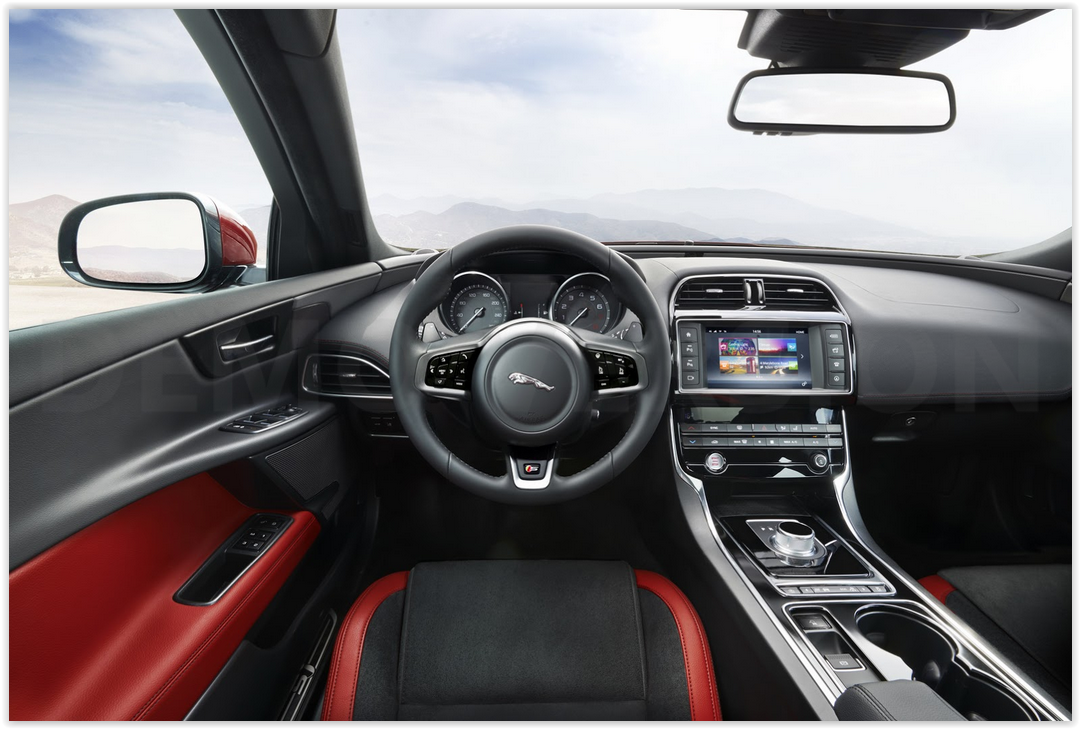
Jaguar has used inspiration from the F-Type for the interior, most notably the dashboard and the instrument panel while a new 8-inch touchscreen is the centerpiece of the center console area.

The touchscreen allows users to connect their iOS or Android device branded "InControl" and control a range of vehicle functions including the climate controls, remote central locking or start the engine.

Wifi hotspot, USB connectivity, bluetooth and audio streaming will be features available on the XE.

Jaguar have not released any information regarding space in the XE whether that be in the cabin or in the boot.


Exterior
Jaguar has given the XE a sleek shape with more than a passing resemblance to it's bigger brother the XF in fact you would be forgiven for thinking it's a facelifted XF.

Short front overhang, longer rear overhang, dynamic cab-rearward stance, sculpted bonnet and a rising waistline create a sense of sportiness.

In fact, Jaguar has taken a lot of inspiration from the F-Type coupe and has the lowest drag coefficient of any Jaguar in history at just 0.26.

Slim head and tail-lights help complete the sleek look of the XE.


My Opinion
I find the exterior of the Jaguar XE rather aesthetically pleasing to the eye and am a fan of the F-Type inspired design.

The interior looks rather nice too although I prefer the look of the interior of the latest Mercedes C-Class but the "InControl" intrigues me the most as being able to control functions of the car from your phone is rather convenient and I see it to be the way of the future with further vehicles to have this ability in the near future.


Saturday, 30 August 2014

2015 Mk6 Nissan Pulsar


Background Information
Nissan re-enter the C-segment after being absent for 8 years with the Almera last appearing in the segment for Nissan, since then Nissan have replaced the Almera with a combination of the crossover Qashqai and part supermini and part small MPV the Note. While the Qashqai has been hugely successful Nissan says the demand is high in the C-segment for a traditional hatchback.

The Pulsar will be manufactured in Barcelona, Spain rather than Sunderland, United Kingdom which surprised a few.

Nissan claims the Pulsar brings "technology, style and sector-leading space to the C-segment".

Prices and trims have been announced for the UK. Prices start from £15,995 for base Visia trimmed model equipped with the 1.2 DIG-T 115PS with a 6 speed manual transmission to £21,945 for a top spec Tekna 1.5 dCi 110PS with a 6 speed manual transmission.

Trims range from base Visia, to Acenta, up to n-tec and topping off with Tekna. All trims come generously equipped as is now typical of Nissan.

Visia trims come equipped with as standard: 5-inch colour touchscreen infotainment system, 16-inch diamond cut alloy wheels, 6 airbags, a single-slot CD player with 4 speakers, bluetooth connectivity, iPod connectivity, steering wheel mounted audio controls, body colour exterior mirrors and door handles, electrically adjustable exterior mirrors, cruise control, speed limiter, stop-start technology called "idle start/stop", manual air conditioning, tyre pressure monitoring system, ABS (Anti-lock Braking System), ESP (Electronic Stability Control), EBD (Electronic Braking Distribution), remote central locking, active trace control and finally "follow me home" lighting.

Acenta trim comes with in addition to Visia trim: 6 speakers, forward emergency braking, auto lights, auto wipers, auto dimming interior rear view mirror, i-Key (keyless entry), engine starter button, dual zone automatic climate control, front fog lights, heated exterior mirrors, leather wrapped steering wheel, leather wrapped gear knob, rear armrest and unique Acenta interior trim.

n-tec comes in addition to Acenta trim: 17-inch diamond cut alloy wheels, rear privacy glass, LED headlight signature, NissanConnect 2 (sat-nav with Google maps, smartphone integration, apps for music/fuel stations with their latest prices, DAB digital radio) with a 7-inch touchscreen infotainment system and reversing camera.

Top spec Tekna trims come equipped in addition to n-tec trim: leather interior, heated front seats, around view monitor, lane departure warning system, blind spot warning system, moving object detection and electric folding exterior mirrors.


Engines
Petrol
1.2 DIG-T 115PS (113BHP) single turbo 4 cylinder
1.6 DIG-T 190PS (187BHP) single turbo 4 cylinder (available from early 2015)

Diesel
1.5 dCi 110PS (108BHP) single turbo 4 cylinder

Torque figures have only been released for the 1.5 dCi 110PS with 260Nm. Torque for the other engines have yet to be released.

A hot Pulsar Nismo is in the works for the future and is expected to come equipped with a 1.6 DIG-T engine tuned to at least 250PS.

6 speed manual transmission is available on the 1.5 dCi 110PS and 1.2 DIG-T 115PS with an Xtronic CVT transmission available as an option on the 1.2 DIG-T 115PS.


Size
Full dimensions have yet to be announced but Nissan promises class leading space in the Pulsar with the longest wheelbase in the class at 2.7m compared to the popular VW Golf mk7 which has a 2.637m long wheelbase and Nissan claims it's more spacious than many vehicles in the D-Segment which include vehicles like the Ford Mondeo, Vauxhall Insignia and VW Passat.


Interior
The interior takes design cues from the Nissan Tilda with a similar look. The center stack looks like as though it was an afterthought as it seems like someone designed a oval center stack and then stuck it on top of the dashboard.

The 3 spoke design steering wheel is lifted straight from the Nissan Qashqai and X-Trail, along with the touchscreen infotainment system and the ventilation controls.


Exterior
The front has a typical Nissan "V-motion" grille along with "boomerang" shaped headlights with "bold and energetic curves on the body sides".

It seems Nissan has tried to inject a sense of style into the otherwise conservative styling of the Pulsar.


My Opinion
I find the Pulsar rather bland with unnecessary curves and creases in the body as though it's trying too hard to be stylish and compete with cars in the segment like the Peugeot 308 and Seat Leon.

I find the shape of the Pulsar rather ungainly too with the rear end particularly ugly IMHO.

The VW Golf may look rather conservative but it doesn't overdo it and try to shout about it's styling.

Overall I see the Pulsar selling in rather reasonable numbers as Nissan have done their research and have found demand for this type of vehicle to justify building it but personally I would go it's rivals or even Nissan's in house brother to the Pulsar, the Qashqai and I would assume many other customers would opt for it once they see it alongside the Pulsar.


Wednesday, 27 August 2014

2015 Mk2 Volvo XC90


 Background Information
Today is a day Volvo fans have been waiting for in many years, the unveiling 2nd generation of the Volvo XC90.

It's been 12 years since Volvo first unveiled the first generation Volvo XC90 in 2002 with subsequent facelifts in 2007 and 2012 so the mk2 XC90 is long overdue.

Volvo is positioning the XC90 to be more upmarket and to take a larger stance against the competition with the German competition being the BMW X5, Audi Q7, Mercedes M-Class, also two British competitors in the form of the Land Rover Discovery and Range Rover Sport and to a lesser extent the Korean Hyundai Santa Fe and Kia Sorento.

3 trim levels have been announced with the base trim called "Momentum" which will gradually be introduced across the board to other Volvo's replacing "SE" trim currently used to instigate entry models across the range. Up next is "R-Design" which will be kept across the range of Volvo cars and finally top spec "Inscription" which will replace "SE Lux" and "Executive" trims across the range.

Momentum trims come with a decent load of kit including sat-nav, auto wipers, LED daytime running lights, LED taillights, 7 seats, dual zone climate control, leather interior and a more basic version of the City Safe System with auto braking. Due to the amount of kit offered as standard, Volvo expect the entry level Momentum trim to be the most popular.

R-Design has yet to be fully detailed but expect larger re-sculpted and sportier bumpers, a subtle rear spoiler and larger alloy wheels along with more standard kit including a more advanced City Safe System and an increase in price.

Inscription trim hasn't been fully detailed either but should have even more kit probably including 22-inch alloys, the full City Safe System and a "Bowers & Wilkins" sound system featuring a 1400W Class D amplifier with 19 "Bowers & Wilkins" speakers dotted around the cabin and a car first air-ventilated subwoofer integrated into the car body.

A limited edition model named "First Edition" with 1927 cars available will be on sale from 3rd September has every option available along with a special interior with a D5 diesel engine and all-wheel-drive on sale for £68,785.

Pricing hasn't been fully released by Volvo UK yet but a Momentum model in D5 AWD guise has been priced at £45,785 with full pricing set to be announced from early October and deliveries from March.


Engines (tbc)
Diesel
2.0 D4 190PS (187BHP) twin turbo 4 cylinder FWD
2.0 D5 225PS (222BHP) twin turbo 4 cylinder 4WD

Petrol
2.0 T5 254PS (251BHP) single turbo, single supercharger 4 cylinder 4WD
2.0 T6 320PS (316BHP) single turbo, single supercharger 4 cylinder 4WD
2.0 T8 Hybrid 399PS (394BHP) single turbo, single supercharger 4 cylinder 315BHP petrol engine mounted with a 79BHP electric motor 4WD

Economy in MPG UK (combined cycle), CO2 emissions (g/km), torque (Nm).

2.0 D4 190PS (187BHP)                56mpg,   N/A,     400Nm
2.0 D5 225PS (222BHP)                47mpg,   N/A,     470Nm
2.0 T5 254PS (251BHP)                  N/A,     N/A,     350Nm
2.0 T6 320PS (316BHP)                  N/A,     N/A,     400Nm
2.0 T8 Hybrid 399PS (394BHP)     109mpg, 60g/km, 640Nm


Size
The wheelbase has grown from 2.857m to 2.984m, an increase of 0.127m which means an increase in rear legroom and cabin space.

The length has increased overall by 0.098m from 4.807m to 4.905m.

Width has increased from 1.935m to 2.140m, an increase of 0.205m.

Height has decreased from 1.784m in the previous generation XC90 to 1.775m. A modest decrease of 0.009m.


Interior
The interior has taken a huge step forward from the previous generation.
A large tablet style touchscreen controls functions from the radio, sat-nav to the climate controls with only a row of buttons present below the touchscreen with switches controlling the hazard lights, heated rear screen, front demister, volume knob with play/pause integrated into it flanked either side by previous/next track buttons and the glovebox release.

The quality of the interior has improved due to it's positioning of being more upmarket with leather being predominant throughout the cabin to inject a sense of quality and luxury.

Volvo claims that the rearmost seats in the 3rd row can accommodate adults up to 5ft 7in or 170cm comfortably.


Exterior
The 2nd generation XC90 retains a similar shape to the 1st generation model with a boxy, practical 4x4 look about it.

T-shaped "Thor's Hammer" (Volvo's choice of words, not mine) LED daytime running lights are present in the headlight units create a new face for Volvo which will be replicated in Volvo's future vehicle's.

New rear LED lights are slimmer than before and blend into the body more readily than previously.


Volvo state, "The overall impression, both exterior and interior, has a strong connection to the key elements of the Swedish lifestyle: the generous space, the celebration of light and the focus on wellbeing."


My Opinion
I think that Volvo has done a fabulous job of the 2nd incarnation of the XC90. With it's more upmarket exterior and the thoroughly modern interior with the center touchscreen controlling nearly all functions to the increase in quality.

The fact that it's a 7-seater SUV that can actually seat 7 is a rare wonder these days with typically only full size MPV's being able to complete the job in hand these days.

Volvo make another step forward to it's vision of no one dying in a Volvo during a car accident by 2020 with the XC90 with the latest in safety in the car industry with 12 sensors placed around the car to the City Safe System that now can acknowledge cars, pedestrians and cyclists and the plethora of airbags equipped on the car it seems like Volvo may be able to pull off, we'll just have to see by the time we reach 2020 and see if the other cars in the Volvo range is as safe as the XC90.


Monday, 25 August 2014

2015 Mk8 VW Passat


Background Information
"Premium class car without premium costs", the words of VW Group Chief Martin Winterkorn to describe the 8th generation of the VW Passat.

The 8th generation of the Passat was unveiled on the 3rd of July at a ceremony held in the VW Design Center in Potsdam with the world media invited to view the event.

Echoing Martin Winterkorn's words, the 8th generation of the Passat has become more upmarket and grown in size to fight vehicles in the compact executive class such as the BMW 3-Series, Audi A4 and the Mercedes C-Class just to name a few.

The 8th generation Passat has lost up to 85kg in weight and is up to 20% more efficient than it's mk7 predecessor.

Prices in the UK have not been released yet, neither have the trims for that matter but we should expect a rise in price and a rise in standard equipment across the range.

Meanwhile in Germany, prices for the Passat Saloon start from €25,875 (£20,652 at current exchange rates) for a 1.4 TSI 125PS in Trendline trim while the Passat Estate starts from €25,950 (£20,713, again at current exchange rates).

Back in the UK, the current Passat Saloon starts at £20,375 while the Estate starts at £21,740.
Expect prices to be in and around £20,750 for the 1.6 TDI 120PS in S trim for the saloon and £22,150 for the estate with the same engine in the same engine.

Trims should be named just like the current range of VW cars in the UK starting with entry level S, mid-spec SE and a top of the range model called GT with the mid-range SE to be replaced later on in it's life by Highline trim as witnessed in the mk6 and mk7 models.


Engines
VW has decided not to bring any petrol engines to the UK citing low demand on the mk7 model so all engines will be diesel with no word on whether the petrol hybrid will be available in the UK.

At launch in Germany the 1.6 TDI 120PS and the rumoured 2.0 TDI 184PS is not available but should be available by the time it is on sale in the UK with deliveries expected in January 2015.


Diesel
1.6 TDI 120PS (118BHP) single turbo 4 cylinder
2.0 TDI 150PS (148BHP) single turbo 4 cylinder
2.0 TDI 184PS (181BHP) single turbo 4 cylinder (unconfirmed)
2.0 TDI 240PS (237BHP) twin turbo 4 cylinder


Size
The mk8 Passat has increased in size overall from the mk7 with size increases/decreases being:
Length:          -2mm
Height:          -14mm
Wheelbase:   +80mm
Width:          +12mm

Overall the dimensions for the saloon are:
Length:         4.767m and 4.866m with a towbar in place
Height:          1.456m
Wheelbase:    2.791m
Width:           1.832m (excluding exterior mirrors) and 2.083m including exterior mirrors


Overall the dimensions for the estate are:
Length:         4.767m and 4.882m with a towbar in place
Height:          1.477m
Wheelbase:    2.791m
Width:           1.832m (excluding exterior mirrors) and 2.083m including exterior mirrors

The boot space of the saloon has been boosted by 21L from 565L to 586L and the estate by 47L from 603L to 650L.


Interior
The whole interior has been redesigned with an emphasis on technology and quality.
An optional Active Info Display replaces the traditional instrument cluster with a 12.3-inch display which can place an emphasis on the dials or the satellite navigation system and can be highly configurable and also comes with a heads up display.

A new generation of park assist is available as an option with 360 degree Area View function with cameras giving a 360 degree view around the vehicle and the car can parallel park or reverse into a bay automatically with the driver only operating the accelerator and brakes.

City Emergency Braking, a world first Trailer Assist, Side Assist with rear traffic alert, Traffic Jam Assist and an Emergency Assist which can steer and bring the vehicle to a stop when sensors in the seat detect that the driver is incapacitated.


Exterior
The designers at Volkswagen have injected a sense of a mini Phaeton into the Passat with more restrained styling and sharp lines.

More chrome is used on the front than in the previous iteration creating a premium feel with sharp angled headlights incorporating full LED technology on top spec models.

The 4 chrome bars on the grille bend towards the headlights with the top bar being thicker than the rest and blending into the headlight design.

Moving round to the side of the vehicle, a strong shoulder line with the exterior door handles being incorporated into the line to give a BMW F30 3-Series and F10 5-Series sort of impression as those cars have this feature too.

The rear of the vehicle seems to have been kept as simple as possible with a straight sided rear with full LED taillights and dual rear exhausts incorporated into the lower rear bumper.


My Opinion
Personally, I would buy it over it's competitors the Ford Mondeo, Peugeot 508, Mazda 6, Kia Optima, Vauxhall Insignia etc the list goes on and on in the D-segment.

The 8th generation Passat stands out from the crowd in it's conservative looks which to some would seem too boring but VW are targeting the class above: the deadly compact executive class where vehicles either are a success or suffer from dire sales, very risky from VW.

If for a company car, the Passat and the BMW 3-Series were on the list, most people would go for the 3-Series. Call me mad but for me I would go for the Passat as I love the looks of it and if I was chugging down the motorway everyday I'd rather have a Passat than a 3-Series as you'd be driving straight for many miles, no chance to enjoy the handling of the 3-Series if I had one and the Passat would cope better in the snow too.

The problem with the Passat is that VW are trying too hard to position it in the compact executive segment but I think it should stay in the D-segment and compete against the likes of the Mondeo and Insignia.


Sunday, 24 August 2014

2015 Seat Leon X-Perience


 Background Information
If I told you 20 years ago, that in 2014 Seat would be releasing a dedicated off-road 4WD Seat Leon Sports Tourer you would think I'm ready to be sent to a mental health unit.
But here we are with Seat announcing that an off-road version of it's stylish Seat Leon ST would be on sale in the UK on the 1st September.

The Leon ST X-Perience gives us a taste of what will be on offer in 2016 when Seat will unveil their first ever proper SUV.

The X-Perience will be a rival to it's fellow VW Group manufacturer, Skoda's Octavia Scout 4x4 (whom it shares parts with), Japanese brand Subaru's Legacy Outback and to some, the Audi A4 Allroad. Some tough competition then.

Seat has raised the ride height by 15mm, providing greater ground clearance to cope with the rough stuff. Power is fed to the 4 wheels by the latest 5th generation Haldex multi-plate clutch connected to 2 different electronic differential lock systems and an electronic stability control system specifically catered for off-roading. In normal driving conditions, eg around town, power is sent to the front wheels only with the system constantly monitoring grip levels with power being sent to the rear wheels in milliseconds when a loss in traction is detected. Seat calls it the "4Drive System".

The X-Perience comes in 2 trims: SE and SE Technology.
Prices start from £24,385 for the 2.0 TDI 150PS diesel engine equipped with a 6 manual transmission in SE trim.
Stepping up to SE Technology trim equipped with the same engine and transmission costs £26,370.
If you want more power, stepping up to the 2.0 TDI 184PS diesel engine with a 6 speed dual clutch semi-automatic transmission in SE Technology trim brings the price to £28,870.

SE trim features 17-inch alloys, black roof rails, dark-tinted rear windows, rear parking sensors, twin exhaust pipes, dual zone climate control, leather wrapped steering wheel with orange stitching and X-Perience badging, sports front seats, hill hold assist and a 5-inch colour touchscreen infotainment system with a proximity sensor.

SE Technology trim features in addition to SE trim: a larger 5.8-inch touchscreen infotainment system including DAB digital radio and satellite navigation, auto lights, auto wipers and auto dimming rear view mirror, LED headlights, LED taillights, electric folding exterior mirrors, 18-inch machined alloy wheels and alcantara upholstery.


Engines
Diesel
2.0 TDI 150PS (148BHP) single turbo 4 cylinder
2.0 TDI 184PS (181BHP) single turbo 4 cylinder


Torque Figures (Nm = Newton Metres), fuel economy in MPG UK (combined cycle), CO2 emissions (g/km) respectively.


2.0 TDI 150PS (148BHP) 6 speed manual               -        320 Nm, 57.6mpg, 126g/km
2.0 TDI 184PS (181BHP) 6 speed DSG semi-auto   -        380 Nm, 55.4mpg, 133g/km


Size
Seat has not released official dimensions of the X-Perience but it should be more or less the same as the standard Leon ST. The figures for the standard ST are:
Length: 4.535m
Width: 1.816m
Height: 1.439m
Wheelbase: 2.636m

The boot size in the standard ST is 587L so the X-Perience should have a similar figure.


Interior
The interior is the same as the as the ST which is no bad thing with differing features being the orange stitched steering wheel with X-Perience badging. 

In SE trim the center stage of the interior is the 5-inch colour touchscreen with a proximity sensor with a larger 5.8-inch in place in the SE Technology trim models.


Exterior
The exterior has the same modern sharp body lines as the standard ST with additional features being the plastic mouldings on the door sills, wheel arches, front and rear bumpers with aluminium plastic detailing on the front and rear bumpers.

The front and rear bumpers offer an improved approach and departure angles when off-roading.
17-inch twin spoke alloys are equipped on SE trim cars while SE Technology cars come equipped with 18-inch machine alloy wheels.


My Opinion
The sharp styling of the Leon X-Perience is a breath of fresh air compared to it's rivals.
In this rather niche market Seat have managed to make the X-Perience a head turner compared to it's rivals.
The X-Perience doesn't just turn heads, it's a very good all rounder too being based on the award winning Seat Leon hatchback which has won awards for being small family car of the year.
If I was in the market for this type, I would opt for it's VW Group rival the Skoda Octavia Scout as it's more spacious, cheaper and just as good off road although it isn't as sharp looking as the Leon X-Perience.


Wednesday, 20 August 2014

2015 Facelifted Mk6 VW Jetta


Background Information
The Volkswagen Jetta has always been overshadowed in the UK by it's smaller hatchback sibling the Golf which is much more popular as the UK seems to have tendency to avoid small saloons.
VW hopes to reverse this trend by releasing the updated Jetta and tempt more buyers into it's small saloon offering.

The Jetta has always sold well in North America as Americans love their saloons.
The mk3 Jetta is produced in Mexico as part of VW's programme of targeting 800,000 annual sales in North America as being produced in Mexico cuts costs which led to the mk3 getting cost cutting measures implemented over it's mk2 predecessor.

70% of parts are designed and manufactured in Puebla, Mexico under the supervision of VW Germany with cost cutting shown in the quality of the plastics with less soft touch plastics used throughout the cabin and leather being substituted with leatherette.

In North America, Jetta models come with a simple torsion beam rear suspension but in the UK, luckily, we have multi-link rear suspension which helps iron out bumps in the ride better than it's North American counterpart.

Pricing for the facelifted Jetta start from £18,815 for the 1.4 TSI 125PS in base S trim equipped with a 6-speed manual transmission rising up to £24,715 for the 2.0 TDI 150PS in top spec GT trim equipped with the 6-speed dual-clutch semi-automatic.

3 trims will be available for the Jetta in the UK: S, SE, GT.

S models come as standard with a DAB digital radio, ESC, a trip computer, front and rear electric windows and manual air conditioning.

Stepping up to SE trim adds on top of S trim 16 inch "Atlanta" alloys which were on pre-facelift vehicles in the now discontinued Sport trim in 1.6 TDI guise and the previous generation mk6 Golf in SE trim, as well as manual lumbar support, bluetooth hands free system, a leather wrapped multifunction steering, Volkswagen's "Multi Device Interface" which includes a USB and an Apple iPhone/iPod lead and finally cruise control.

Top of the range GT replaces Sport and includes 15mm lower suspension, 17 inch "Lancaster" alloys, front fog lights, front sports seats, automatic lights, rain sensor (auto wipers), auto dimming rear-view interior mirror, heat-insulating dark tinted rear glass (rear windows & rear screen), a colour multifunction trip computer in between the instrument dials, a driver alert system and ambient interior lighting.


Engines
Petrol
1.4 TSI 125PS (123BHP) single turbo 4 cylinder
1.4 TSI 150PS (148BHP) single turbo 4 cylinder

Diesel
2.0 TDI 110PS (108BHP) single turbo 4 cylinder
2.0 TDI 150PS (148BHP) single turbo 4 cylinder

0-62mph, top speed, CO2 emissions in each engine: (s = seconds, g/km = grams per kilometre, n/a = not applicable, m/t = manual transmission, a/t = automatic transmission)
1.4 TSI 125PS       9.6s       128mph      125g/km(m/t)      n/a
1.4 TSI 150PS       8.6s       136mph      123g/km(m/t)      117g/km(a/t)
2.0 TDI 110PS      11s        122mph      105g/km(m/t)      109g/km(a/t)
2.0 TDI 150PS      8.9s       135mph      109g/km(m/t)      120g/km(a/t)

Fuel Economy (MPG UK)
                                            Urban        Combined        Extra Urban  
1.4 TSI 125PS(m/t)                40.9              52.3                  62.8
1.4 TSI 150PS(m/t)                41.5              53.3                  64.2
1.4 TSI 150PS(a/t)                 45.6              55.4                  64.2
2.0 TDI 110PS(m/t)               57.6              70.6                  78.5
2.0 TDI 110PS(a/t)                58.9              67.3                  72.4
2.0 TDI 150PS(m/t)               56.5              67.3                  74.3
2.0 TDI 150PS(a/t)                51.4              62.8                  68.9


 Size
The facelifted mk6 Jetta has the same dimensions as the pre-facelift mk6 Jetta measuring 4.64m in length, 1.78m in width, 1.45m in height and a wheelbase of 2.65m.
The boot has a capacity of 510L with the rear seats up and 60/40 split fold rear seats come as standard,


Interior
The interior has gained new dials which are now recessed and a new flat bottomed steering wheel carried over from the Golf mk7.

Disappointingly VW have not fitted the latest touchscreen infotainment system from the mk7 Golf in the Jetta and instead fitted the same as in the pre-facelifted model which can be had with a standard CD-radio RNS 210 in the S models, a CD-radio RNS in the SE and GT models or an optional 5.0 inch touchscreen RNS 315 with sat-nav with VW having removed the optional larger 6.5 inch touchscreen RNS 510 with optional sat-nav from the options list.
New options include blind spot detection with rear cross traffic alert.

Exterior
It takes a keen eye or a die hard VW Jetta fan to spot the differences between the pre and post facelift models with the facelifted model having a redesigned grille now having 3 slats across as opposed to the previous 2, redesigned front and rear bumpers, optional bi-xenon headlights with an adaptive front lighting system, square shaped front fog lights, new squarer-shaped boot lid and new rear light design/shape.
VW claims the new radiator and bumpers now make the Jetta 10% more aerodynamic.

My Opinion
I've always liked the Jetta and the concept of it being a saloon version of a Golf sized vehicle.
But it's kinda sad to see it doesn't sell well as consumers are either opting to buy the smaller Golf or the larger Passat and it seems to be in it's little niche, at least in the UK, with it's main competitor being the Mazda 3 Fastback with other more costly rivals being the Audi A3 saloon and the Mercedes CLA.

I personally am against the cost cutting that VW has implemented in the mk6 Jetta as I have been in a pre-facelifted model and the plastics used on the top of the doors are rock hard and scratchy in comparison to the smaller Golf and the larger Passat, almost like in the Polo.
Despite this the doors still sound like a typical German car, solid, nicely weighted and giving a nice "thump".

With rising sales of the Mazda 3 Fastback with almost 40% opting for it over the hatchback variant could we see a resurgence of the small saloon in the UK? I certainly hope so and hope that VW Jetta sales rise too!